Plantation shutters vs. faux wood blinds is a common comparison for Orange County homeowners choosing custom window coverings. Both options offer attractive designs, practical light control, and privacy, but they differ in appearance, durability, operation, and price.
If you’re deciding between plantation shutters and faux wood blinds for your home, understanding these differences can help you choose the right option for each room.
At Blackout Blinds & Shutters, we help homeowners explore custom blinds, shutters, and other window-covering products to match their style, preferences, and budget.
In this guide, we’ll compare plantation shutters and faux wood blinds so you can make a more informed purchasing decision.
Here’s what you should know before choosing between plantation shutters and faux wood blinds.
What Is the Difference Between Plantation Shutters and Faux Wood Blinds?
The biggest difference is their construction.
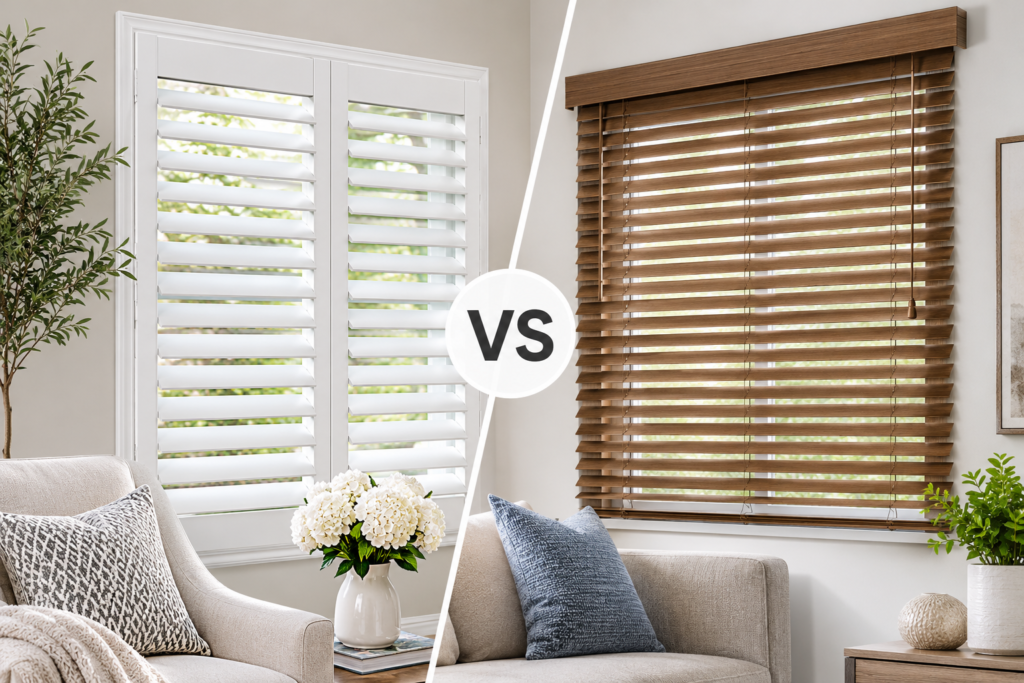
Plantation shutters are structured window coverings made with a frame and hinged panels containing adjustable horizontal louvers. The panels can typically be opened to expose the window or closed for privacy and light control.
Faux wood blinds consist of horizontal synthetic slats connected by a ladder and operating mechanism. The slats tilt to adjust sunlight and privacy, and the blind can be raised or lowered.
Although both products can have a similar white or wood-inspired finish, plantation shutters generally have a more architectural appearance.
Quick Comparison: Plantation Shutters vs. Faux Wood Blinds
| Feature | Plantation shutters | Faux wood blinds |
|---|---|---|
| Appearance | Built-in, architectural look | Classic horizontal slats |
| Construction | Framed panels with louvers | Individual synthetic slats |
| Upfront cost | Generally higher | Generally lower |
| Light control | Adjustable louvers and panels | Adjustable slats |
| Privacy | Strong when properly closed | Good, with some light gaps |
| Moisture resistance | Depends on shutter material | Generally good |
| Cleaning | Relatively simple surfaces | Requires attention to individual slats |
| Operation | Panels open; louvers tilt | Slats tilt; blind raises and lowers |
| Best for | Long-term design upgrade | Practical, budget-conscious coverage |
Both can be attractive choices. The best one depends on your budget, window dimensions, room conditions, and preferred style.
1. Appearance: Which Looks Better?
Appearance is often the first thing homeowners notice when comparing these products.
Plantation Shutters: A More Built-In Appearance
Plantation shutters create a structured, finished look because their frames and panels are designed to fit the window opening.
Their wider louvers give windows a distinctive architectural appearance.
They work especially well with:
- Traditional interiors
- Coastal-inspired homes
- Transitional designs
- Contemporary spaces with clean finishes
- Homes with decorative window trim
White plantation shutters are especially popular because they complement many interior color schemes.
Faux Wood Blinds: Classic and Versatile
Faux wood blinds provide the familiar appearance of horizontal wood-style slats.
They are available in a variety of colors and finishes, including white, off-white, and wood-inspired tones.
They can complement:
- Traditional living rooms
- Casual family spaces
- Bedrooms
- Kitchens
- Home offices
Which looks better?
Choose plantation shutters if you prefer a substantial, built-in appearance.
Choose faux wood blinds if you prefer a simpler, more traditional blind design.
2. Cost: Which Is More Affordable?
For many homeowners, budget is one of the most important factors.
In general, faux wood blinds cost less upfront than custom plantation shutters.
Plantation shutters typically involve more substantial materials, framed construction, custom sizing, and additional manufacturing requirements.
The final price of either option depends on:
- Window width and height
- Material and product quality
- Louver or slat dimensions
- Frame configuration
- Color and finish
- Specialty window shapes
- Product brand and features
Why Are Plantation Shutters Usually More Expensive?
Plantation shutters are more substantial than conventional blinds.
Their frames and hinged panels are designed around the window opening, which can make them a larger initial purchase.
Why Are Faux Wood Blinds More Budget-Friendly?
Faux wood blinds use a relatively straightforward slat-and-headrail construction.
This makes them a practical option when you need to cover multiple windows while keeping the overall product budget under control.
Our recommendation: If you’re covering an entire home and upfront cost is a priority, compare faux wood blinds first. If you want a more substantial appearance in your main living spaces, request pricing for plantation shutters as well.
3. Durability: Which Lasts Longer?
Durability depends on the quality of the materials, manufacturing, window conditions, and everyday use.
Plantation Shutters
Quality plantation shutters are designed as a substantial window-covering product.
Their framed construction and sturdy louvers can provide long-term performance when the material is appropriate for the environment and the product is properly maintained.
They are worth considering for windows where you want a more permanent-looking design.
Faux Wood Blinds
Faux wood blinds are also practical and durable for everyday use.
Their synthetic slats are generally more resistant to moisture than natural wood, making them useful in kitchens and bathrooms.
However, individual slats and operating components can be damaged by rough handling or repeated impact.
Which should you choose?
Plantation shutters may be preferable if you want a substantial, long-term window-covering option.
Faux wood blinds are a practical choice when you want useful everyday performance at a lower initial cost.
4. Moisture Resistance: Which Is Better for Kitchens and Bathrooms?
Moisture resistance is especially important when selecting window coverings for rooms exposed to steam, humidity, or occasional splashes.
Faux Wood Blinds
Faux wood blinds are typically made from PVC, vinyl, or composite materials designed to tolerate moisture better than natural wood.
This makes them a practical option for:
- Bathrooms
- Kitchens
- Laundry rooms
- Utility areas
Plantation Shutters
The moisture resistance of plantation shutters depends on their construction material.
Composite and synthetic shutters can be suitable for humid spaces, while natural wood shutters require more care and are generally less appropriate for areas with frequent moisture exposure.
Always check the manufacturer’s specifications for the exact product.
Best choice: Faux wood blinds are a straightforward moisture-conscious option. Composite plantation shutters may also work well if the selected product is specifically designed for the room’s conditions.
5. Light Control: Which Gives You More Flexibility?
Both plantation shutters and faux wood blinds allow you to adjust incoming sunlight without raising the entire window covering.
However, their operation is different.
Plantation Shutters
Plantation shutters use adjustable louvers.
You can tilt them to:
- Direct sunlight toward the ceiling
- Reduce glare
- Maintain privacy
- Allow softer natural light into the room
You can also open the shutter panels when you want a clearer view through the window.
Faux Wood Blinds
Faux wood blinds use adjustable horizontal slats.
Tilting the slats changes how much light enters and how visible the interior is from outside.
You can also raise the blind to expose more of the window.
Which is better?
Both offer useful light control. Plantation shutters provide a more substantial panel-and-louver design, while faux wood blinds offer the flexibility of tilting and raising the entire blind.
Neither option should automatically be considered a blackout solution. Light can enter through the gaps between louvers or slats and around the window covering.
6. Privacy: Which Is Better for Bedrooms and Street-Facing Windows?
Privacy is another important consideration, especially for homes near sidewalks, neighboring properties, or busy streets.
Plantation Shutters
When their panels are closed and louvers are properly adjusted, plantation shutters provide a strong sense of privacy.
Their framed construction can also reduce some of the gaps around the window, depending on the design and fit.
Faux Wood Blinds
Faux wood blinds also provide good privacy when their slats are closed.
However, small gaps between slats and around the edges may allow some light or visibility.
Our recommendation: Both products can work well for bedrooms and street-facing windows. Compare the actual product design and mounting configuration if minimizing gaps is particularly important.
7. Cleaning and Maintenance
Window coverings collect dust over time, so consider how much maintenance you’re comfortable doing.
Cleaning Plantation Shutters
Plantation shutters have broad, accessible surfaces that can generally be cleaned with:
- A microfiber cloth
- A soft duster
- A slightly damp cloth when permitted by the manufacturer
Their wider louvers can make routine dusting relatively straightforward.
Cleaning Faux Wood Blinds
Faux wood blinds have multiple horizontal slats, which means there are more individual surfaces to clean.
Common cleaning methods include:
- Dusting with a microfiber cloth
- Using a suitable blind duster
- Wiping slats individually with a lightly damp cloth when permitted
Avoid soaking either product or using harsh cleaning chemicals unless the manufacturer specifically allows them.
Which is easier to maintain?
Plantation shutters may be easier to wipe down because of their broader surfaces. Faux wood blinds are also manageable, but cleaning between the individual slats can take more time.
8. Which Is Better for Orange County’s Sunny Climate?
Orange County receives abundant sunshine, and some homes experience strong afternoon glare through west-facing windows.
Both plantation shutters and faux wood blinds can help manage incoming light.
Plantation Shutters for Sunny Rooms
Plantation shutters allow you to tilt the louvers to control direct sunlight and privacy.
Their solid construction may also provide some insulating benefit, depending on the material, fit, and window conditions.
Faux Wood Blinds for Sunny Rooms
Faux wood blinds allow you to angle the slats to redirect incoming sunlight.
This is useful when you want to reduce direct glare without completely closing off the window.
What About Heat Reduction?
Neither product automatically guarantees a specific reduction in indoor temperature or energy bills.
Performance depends on factors such as:
- Window glass and existing insulation
- Material and construction
- Window orientation
- Fit and coverage
- How the louvers or slats are positioned
If heat control is your main concern, compare manufacturer specifications and consider other solar-control options, including cellular and solar shades.
9. Which Is Better for Different Rooms?
The best choice can vary throughout your home.
| Room | Plantation shutters | Faux wood blinds |
|---|---|---|
| Living room | Excellent for a polished, architectural look | Practical and versatile |
| Bedroom | Good privacy and adjustable light | Budget-friendly privacy and light control |
| Kitchen | Suitable when the material is moisture-appropriate | Practical moisture-resistant option |
| Bathroom | Choose a suitable composite or synthetic material | Good option for moisture-prone rooms |
| Dining room | Strong design feature | Simple, classic appearance |
| Home office | Adjustable light and privacy | Flexible light control |
You don’t have to choose the same window covering for every room.
Some homeowners use plantation shutters in prominent living spaces and faux wood blinds in secondary bedrooms, kitchens, or other areas where budget and practicality matter more.
10. Are Plantation Shutters Worth the Higher Price?
Plantation shutters can be worth the higher upfront investment if you value their appearance, construction, and custom fit.
They can create a coordinated look throughout the home and are often selected as a longer-term design choice.
However, whether they’re worth the additional cost depends on your priorities.
Consider plantation shutters if:
- You plan to stay in your home for many years.
- You prefer a built-in appearance.
- You want substantial framed window coverings.
- You value the design consistency of shutters.
Consider faux wood blinds if:
- You want to cover several windows at a lower cost.
- You prefer a traditional horizontal blind.
- You need a moisture-conscious option.
- You want flexible light adjustment and straightforward operation.
Neither product guarantees a higher resale price. Choose based on the features and appearance you value in your own home.
Frequently Asked Questions
Are plantation shutters better than faux wood blinds?
Plantation shutters are often preferred for their substantial construction and built-in appearance. Faux wood blinds are generally more affordable and practical for everyday window coverage. The better option depends on your budget and design priorities.
Are faux wood blinds cheaper than plantation shutters?
Yes. Faux wood blinds generally have a lower upfront product cost because their construction is simpler and less substantial than custom framed shutters.
Do plantation shutters provide better privacy?
Plantation shutters can provide excellent privacy when properly fitted and closed. Faux wood blinds also provide good privacy, although gaps between slats may allow some light or visibility.
Are faux wood blinds good for bathrooms?
Yes. Many faux wood blinds use moisture-resistant synthetic materials, making them suitable for bathrooms. Always confirm the manufacturer’s care and moisture-resistance specifications.
Do plantation shutters help keep a room cooler?
Their solid construction may help moderate heat transfer, depending on the material and fit. However, actual performance varies, and they should not be considered a guaranteed substitute for efficient windows or other cooling measures.
Are plantation shutters hard to clean?
Generally, no. Their wider louvers can be wiped with a microfiber cloth or soft duster. Follow the manufacturer’s cleaning instructions for your specific material.
Can I use plantation shutters and faux wood blinds in the same home?
Absolutely. You can choose plantation shutters for main living areas and faux wood blinds for bedrooms, bathrooms, or other spaces. Mixing styles can help balance appearance and budget.
Where can I buy custom plantation shutters and faux wood blinds in Orange County?
Blackout Blinds & Shutters helps Orange County homeowners explore custom window-covering products, including blinds and shutters. Contact the business to ask about available styles and product pricing.
Shop Plantation Shutters and Faux Wood Blinds in Orange County, CA
When comparing plantation shutters vs. faux wood blinds, the right decision comes down to what matters most to you.
Choose plantation shutters if you want a more substantial, built-in appearance and are comfortable with a higher upfront investment.
Choose faux wood blinds if you want practical light control, moisture-resistant materials, and a more budget-friendly product.
Both can complement an Orange County home when selected for the right room and window.
At Blackout Blinds & Shutters, we help homeowners compare custom blinds, shades, shutters, and motorized window-covering products.
Ready to compare your options?
Contact Blackout Blinds & Shutters to discuss available styles, customization options, and product pricing.