Compare sunlight control, privacy, heat reduction, style, and cost before choosing your next custom window shades.
If you’re shopping for new window shades in Orange County, California, you’ve probably come across two popular options: solar shades vs roller shades.
Both offer a sleek, modern appearance. Both work well with large windows. And both can help manage the bright California sunshine.
But which one is better for your home?
The answer depends on what matters most to you: reducing glare, maintaining your outdoor view, creating privacy, or blocking sunlight in bedrooms.
At Blackout Blinds & Shutters, we help Orange County homeowners explore custom window coverings that fit their style and everyday needs.
In this guide, we’ll explain the differences between solar shades and traditional fabric roller shades so you can make a confident purchasing decision.
What Is the Difference Between Solar Shades and Roller Shades?
The most important thing to understand is that solar shades are actually a type of roller shade.
Both use a fabric panel that rolls up and down around a tube.
The main difference is the fabric.
Solar shades typically use woven screen materials designed to filter sunlight, reduce glare, and maintain some outdoor visibility.
Traditional roller shades come in a wider range of fabrics, including sheer, light-filtering, room-darkening, and blackout materials.
In other words, the real comparison is usually between solar screen shades and fabric roller shades.
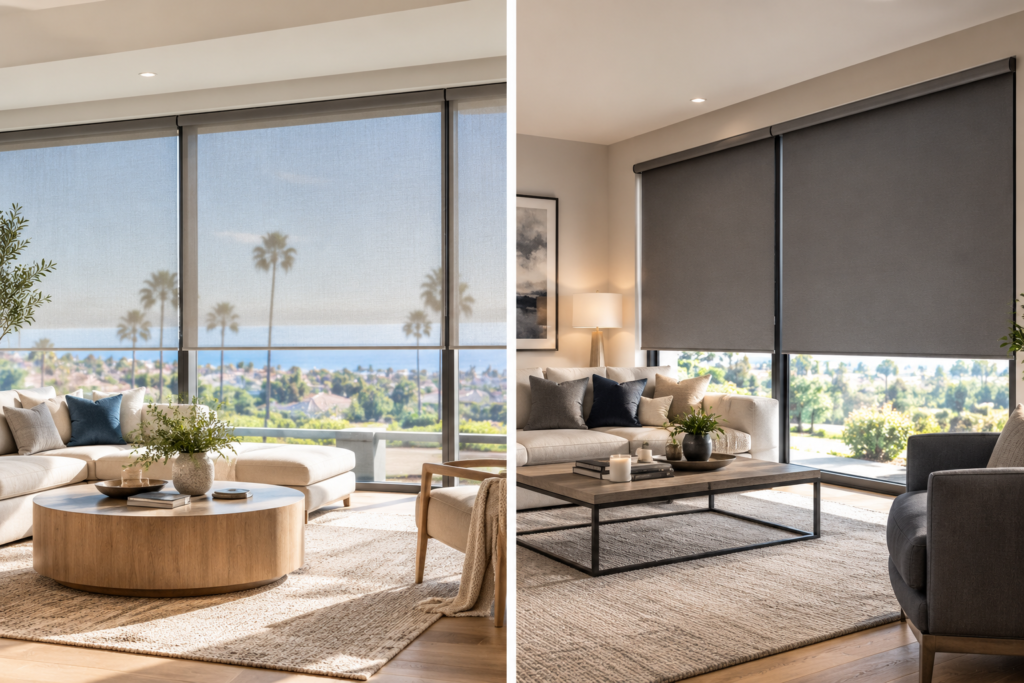
Solar Shades vs. Roller Shades: Quick Comparison
| Feature | Solar shades | Traditional roller shades |
|---|---|---|
| Main purpose | Glare and solar control | Flexible light and privacy control |
| Outdoor view | Often maintained during daylight | Usually reduced when lowered |
| Daytime privacy | Depends on fabric and lighting | Depends on fabric opacity |
| Nighttime privacy | Often limited | Better with opaque fabrics |
| Blackout options | Generally no | Yes |
| Heat control | Depends on screen fabric | Depends on fabric and reflectivity |
| Design style | Modern and minimal | Modern and versatile |
| Motorization | Available | Available |
Both are excellent options, but they solve different problems.
What Are Solar Shades?
Solar shades, sometimes called solar screen shades, are window coverings made with specialized woven fabrics.
They are designed to reduce harsh sunlight and glare while allowing you to see outside to varying degrees.
This makes them particularly appealing for Orange County homes with beautiful backyard views, patios, or large living room windows.
Benefits of Solar Shades
1. Reduce glare without completely closing off the view
Solar shades can make bright living rooms and home offices more comfortable while preserving some daytime outdoor visibility.
2. Help manage incoming sunlight
Their screening fabrics can reduce direct solar exposure. The level of performance depends on the specific material, color, openness factor, and window conditions.
3. Complement modern interiors
Solar shades have a clean, streamlined appearance that works well in contemporary homes.
4. Work well on large windows
They are a popular choice for wide living room windows and sliding glass doors, subject to product size limitations.
Potential Disadvantages of Solar Shades
Solar shades generally do not provide complete nighttime privacy.
During the day, when outdoor light is brighter than indoor light, you may be able to see outside while limiting visibility into the room.
At night, when interior lights are on, that effect can reverse.
They are also not designed to create the darkness of a blackout shade.
Best for: Living rooms, home offices, dining areas, and spaces where glare reduction and outdoor views are priorities.
What Are Roller Shades?
Traditional roller shades use a continuous piece of fabric that rolls neatly into a compact mechanism above the window.
Their biggest advantage is versatility.
Depending on the fabric you choose, roller shades can provide soft daylight, strong privacy, or substantial light blocking.
Types of Roller Shade Fabrics
Light-filtering roller shades
These fabrics diffuse incoming sunlight and create a softer glow. They are ideal for living rooms and common areas where you want natural light without harsh brightness.
Room-darkening roller shades
These reduce more light than typical light-filtering fabrics and are useful for bedrooms, television rooms, and spaces where stronger light control is desired.
Blackout roller shades
Blackout fabric prevents light from passing through the material, making it a popular choice for bedrooms and media rooms.
However, light can still enter around the edges of a shade unless additional light-blocking features are used.
Benefits of Roller Shades
- Wide range of fabric colors and textures
- Light-filtering, room-darkening, and blackout choices
- Strong privacy options
- Clean, minimalist design
- Manual and motorized operating options
- Custom sizing for many window configurations
Potential Disadvantages of Roller Shades
Opaque roller shades generally block the outdoor view when lowered.
And while certain roller fabrics can help manage solar heat gain, not every roller shade is specifically engineered for solar screening.
Best for: Bedrooms, bathrooms, media rooms, nurseries, and living spaces where privacy or flexible light control matters most.
Solar Shades vs. Roller Shades for Heat Control
One of the most common questions Orange County homeowners ask is:
Which shades are better for keeping a room cooler?
Both solar shades and roller shades can help reduce unwanted sunlight entering a room.
However, neither category is automatically better in every situation.
Solar shade fabrics are designed for solar screening, but their performance varies considerably.
Traditional roller shades can also provide effective solar control, especially when made with reflective or specialized fabrics.
For a west-facing window that receives intense afternoon sun, consider:
- The fabric’s solar reflectance
- How much sunlight passes through the material
- Whether maintaining an outdoor view is important
- How closely the shade fits the window
- Whether the shade will be closed during peak sunlight hours
If energy performance is your main priority, ask about manufacturer specifications or independent window-attachment energy ratings.
Which Is Better for Orange County’s Sunny Climate?
If you want to reduce glare while still seeing your backyard, solar shades may be the better fit.
If you prefer to block most incoming light and create a darker room, opaque or blackout roller shades may be better.
The ideal choice depends on the room, the window orientation, and the exact fabric selected.
Solar Shades vs. Roller Shades for Privacy
Privacy is one of the biggest differences between these two window-covering options.
Solar Shades for Privacy
Solar shades can provide a degree of daytime privacy, but they are not generally reliable for privacy after dark.
Even a tightly woven solar screen may allow silhouettes or interior details to become visible under certain lighting conditions.
Roller Shades for Privacy
Roller shades with opaque fabrics are generally a stronger choice for privacy.
When lowered, they prevent direct visibility through the fabric.
For bedrooms and bathrooms, this can be a significant advantage.
Our recommendation: If nighttime privacy is essential, prioritize an opaque roller shade rather than relying on a solar screen fabric.
Understanding Solar Shade Openness Factors
When shopping for solar shades, you’ll often see percentages such as 1%, 3%, 5%, and 10%.
These refer to the fabric’s openness factor, or the approximate proportion of open space in the weave.
| Openness factor | Typical effect |
|---|---|
| 1% | Tighter weave, less view-through, stronger glare control |
| 3% | Good balance between screening and outdoor visibility |
| 5% | More view-through and natural daylight |
| 10% | Greater outdoor visibility, lighter screening |
A lower openness factor generally means a tighter weave, but it does not guarantee better heat or UV performance in every product.
Fabric color, coating, and material composition also affect results.
For sunny Orange County living rooms, 3% and 5% openness fabrics are useful options to compare, depending on your preferred balance of glare control and visibility.
Which Is Better for Different Rooms?
Living Room: Solar Shades
If your living room has large windows and you enjoy looking outside, solar shades can reduce glare while keeping the room visually connected to the outdoors.
Bedroom: Blackout Roller Shades
For bedrooms, blackout roller shades are generally the better choice when darkness and privacy are top priorities.
Home Office: Solar Shades
Solar shades can help reduce screen glare while maintaining daylight, making them attractive for home offices.
Bathroom: Privacy-Focused Roller Shades
Opaque roller shades made from suitable moisture-resistant materials are worth considering for bathrooms.
Media Room: Blackout Roller Shades
For television and movie viewing, blackout roller shades provide stronger light control than typical solar screens.
Sliding Glass Doors: Either Option
Both solar and traditional roller shades can work well on large glass doors, provided the selected product supports the required dimensions and operating clearance.
Are Solar Shades or Roller Shades More Expensive?
The price depends on the specific fabric, window dimensions, operating mechanism, and optional features.
For either category, pricing can increase with:
- Larger or unusually shaped windows
- Premium fabrics
- Decorative hardware or cassettes
- Motorized operation
- Specialty light-control features
- Custom configurations
Solar screen fabrics may cost more than some basic roller shade fabrics, but premium blackout or designer roller shades can also be more expensive.
Rather than assuming one category is always cheaper, compare quotes for the same window measurements and operating features.
At Blackout Blinds & Shutters, you can request product pricing based on the styles and specifications you’re considering.
Can Solar Shades and Roller Shades Be Motorized?
Yes. Many solar shades and traditional roller shades are available with motorized operation.
Motorization can be especially convenient for:
- Tall or hard-to-reach windows
- Large living room windows
- Multiple shades in one room
- Homes with frequent afternoon sun exposure
- Homeowners who prefer remote or app-based controls
Depending on the motor and control system, certain products may support scheduled operation or selected smart-home integrations.
Explore motorized shades and motorized blinds to learn more about available options.
What About Dual Roller Shades?
If you like the benefits of both solar shades and blackout roller shades, a dual roller shade system may be worth considering.
These systems use two separate shade layers on one window.
For example:
- A solar screen layer for daytime glare control and outdoor visibility
- A blackout layer for nighttime privacy and stronger light blocking
This combination can be useful in Orange County bedrooms with scenic views or living rooms that double as media spaces.
Availability, hardware dimensions, and pricing vary by product.
How to Choose Between Solar Shades and Roller Shades
Before ordering custom shades, answer these five questions:
1. Do I want to see outside when the shade is lowered?
If yes, consider solar shades.
2. Is nighttime privacy essential?
If yes, consider opaque roller shades.
3. Do I need to darken the room for sleep or television?
If yes, compare blackout roller shades.
4. Does the room receive strong afternoon sunlight?
If yes, compare fabrics specifically for solar control and glare reduction.
5. Would motorized operation make daily use easier?
If yes, ask about motorized options for your preferred shade style.
Frequently Asked Questions
Are solar shades better than roller shades?
Solar shades are better for certain needs, especially reducing glare while preserving some outdoor visibility. Traditional roller shades offer more fabric options for privacy and room darkening.
Can you see through solar shades at night?
Often, yes. With interior lights on, people outside may be able to see through solar shade fabric. Solar shades should not be treated as guaranteed nighttime privacy coverings.
Do solar shades block heat?
Solar shades can reduce solar exposure and help manage heat gain, but the results depend on the fabric and window conditions. Compare actual product specifications when heat control is your priority.
Are roller shades good for bedrooms?
Yes. Room-darkening and blackout roller shades are popular bedroom choices because they provide privacy and strong light control.
Are solar shades the same as blackout shades?
No. Solar shades use screen fabrics designed for sunlight filtering and view preservation. Blackout shades use opaque materials designed to prevent light from passing through the fabric.
Can I get custom solar shades in Orange County?
Yes. Blackout Blinds & Shutters helps Orange County homeowners explore custom window-covering options based on window dimensions, design preferences, and functional needs.
Shop Custom Solar Shades and Roller Shades in Orange County, CA
When comparing solar shades vs. roller shades, the best choice comes down to how you want each room to function.
Choose solar shades if you want to manage glare, soften bright sunlight, and preserve outdoor views during the day.
Choose traditional roller shades if you want more flexibility in fabric opacity, especially for nighttime privacy or blackout light control.
For some rooms, a dual shade system may provide the best combination of features.
At Blackout Blinds & Shutters, we help homeowners throughout Orange County explore custom blinds, shades, shutters, and motorized window coverings.
Ready to compare styles and request pricing?
Contact Blackout Blinds & Shutters to discuss the window-covering products that suit your home.